What Features Should Businesses Look for Before Choosing an AI Healthcare Solution?
- 12 hours ago
- 12 min read

The healthcare industry is rapidly evolving toward AI-driven digital transformation, where hospitals, healthcare startups, diagnostic centers, and enterprise providers are adopting intelligent technologies to improve patient care and operational efficiency. Modern healthcare AI systems now support predictive analytics, automation, remote monitoring, intelligent diagnostics, and real-time decision-making. However, choosing the right AI healthcare solution requires careful evaluation of scalability, compliance, security, interoperability, and long-term ROI. Businesses must invest in platforms that not only optimize workflows but also enable future-ready, secure, and patient-centric healthcare innovation.
Why AI Healthcare Solutions Are Becoming Essential for Modern Enterprises
The global healthcare industry is experiencing a major digital transformation driven by artificial intelligence, automation, and data-driven technologies. Modern healthcare enterprises—including hospitals, telemedicine providers, diagnostic centers, pharmaceutical companies, and healthcare startups—are generating massive volumes of patient and operational data every day. Managing this growing ecosystem manually often leads to inefficiencies, delayed decision-making, higher operational costs, compliance risks, and fragmented patient experiences.
To overcome these challenges, organizations are increasingly adopting advanced AI healthcare services that improve clinical accuracy, streamline administrative workflows, and enhance overall healthcare delivery. Artificial intelligence enables healthcare providers to process large datasets in real time, automate repetitive tasks, identify medical patterns faster, and support more informed clinical decisions.
Today, enterprises are leveraging AI-powered technologies for:
Predictive healthcare analytics
AI-assisted diagnostics
Intelligent patient monitoring
Virtual healthcare assistants
Automated medical documentation
Smart scheduling and appointment systems
Remote patient care and telemedicine
Personalized treatment recommendations
Modern healthcare AI systems are also helping organizations improve patient engagement, reduce physician burnout, optimize hospital resource management, and deliver more personalized healthcare experiences.
As healthcare becomes increasingly data-centric, businesses now require scalable, secure, and interoperable enterprise AI healthcare solutions capable of integrating seamlessly with existing healthcare infrastructure while meeting strict regulatory standards such as HIPAA, GDPR, HL7, and FHIR.
In addition, the growing adoption of Machine Learning in Healthcare is enabling enterprises to improve disease prediction, automate medical imaging analysis, enhance clinical decision support, and develop more accurate treatment strategies through continuous data learning and predictive intelligence.
What Is an AI Healthcare Solution?
An AI healthcare solution is an advanced digital platform or software system that uses artificial intelligence, machine learning, automation, and data analytics to improve healthcare operations, enhance clinical decision-making, and deliver better patient outcomes. These intelligent systems help healthcare organizations automate complex workflows, process large volumes of medical data, reduce human errors, and provide faster, more accurate healthcare services.
Unlike traditional healthcare software, modern AI-driven solutions are designed to learn from healthcare data, identify patterns, generate predictive insights, and support real-time decision-making across medical and administrative environments. They play a critical role in helping healthcare providers improve efficiency, reduce operational costs, and deliver more personalized patient care experiences.
Today’s AI-powered healthcare software can support a wide range of healthcare functions, including:
AI-assisted diagnostic systems
Telemedicine and virtual consultation platforms
Clinical decision support systems
Intelligent patient monitoring tools
Healthcare chatbots and virtual assistants
Predictive healthcare analytics
Smart Electronic Health Record (EHR) systems
AI-driven medical imaging solutions
Automated healthcare workflow management
Modern enterprise AI healthcare solutions are built to support large-scale healthcare ecosystems such as hospitals, clinics, pharmaceutical companies, diagnostic centers, and healthcare startups. These platforms are designed with advanced security, scalability, interoperability, and compliance capabilities to ensure seamless integration with existing healthcare infrastructure while meeting healthcare regulations such as HIPAA, GDPR, HL7, and FHIR.
As digital healthcare adoption continues to grow, intelligent healthcare AI systems are becoming essential for organizations seeking to improve operational performance, enhance patient engagement, and build future-ready healthcare ecosystems.
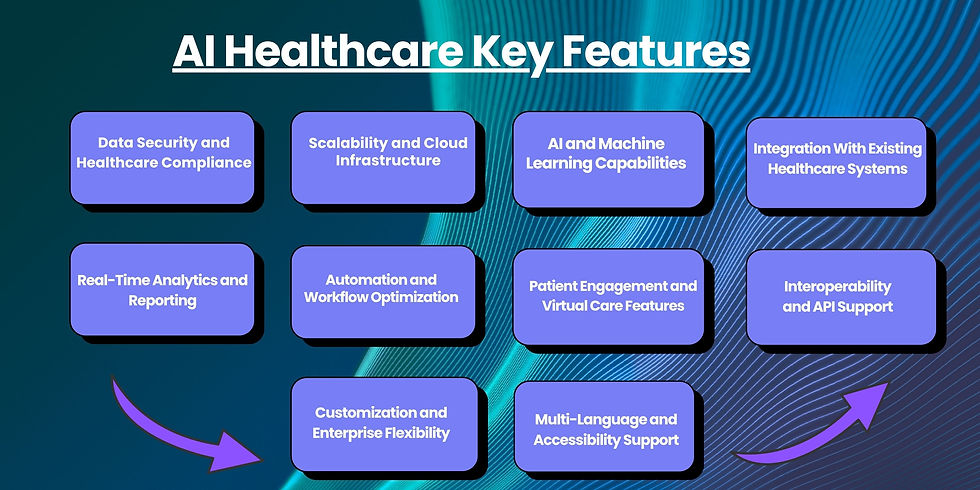
Core Features Businesses Should Evaluate Before Choosing an AI Healthcare Solution
Selecting the right AI healthcare solution requires more than comparing software features or pricing models. Healthcare organizations must evaluate whether the platform can support long-term scalability, regulatory compliance, operational efficiency, and intelligent patient care delivery. Modern healthcare enterprises need secure, interoperable, and data-driven systems capable of adapting to rapidly evolving healthcare demands and digital transformation strategies.
Below are the most important features businesses should carefully assess before investing in an AI healthcare platform.
Data Security and Healthcare Compliance
Healthcare organizations manage highly sensitive patient records, financial information, medical histories, and real-time clinical data every day. Because of this, data security and regulatory compliance are among the most critical factors when selecting an AI healthcare solution.
Modern healthcare AI systems must comply with global healthcare regulations and industry standards such as:
HIPAA
GDPR
HL7
FHIR
SOC 2
ISO healthcare standards
A secure AI healthcare platform should include:
End-to-end encryption
Role-based access control
Multi-factor authentication
Secure cloud infrastructure
Protected APIs
Advanced data governance frameworks
Without proper cybersecurity architecture and compliance protocols, healthcare organizations may face serious risks including data breaches, operational disruption, financial penalties, and reputational damage. Businesses should always prioritize AI healthcare providers that maintain strict compliance and enterprise-grade security practices.
Scalability and Cloud Infrastructure
As healthcare organizations expand, their technology infrastructure must support increasing volumes of patient data, users, departments, and connected devices. A scalable AI healthcare platform ensures long-term operational stability without compromising performance or user experience.
Modern cloud-native enterprise AI healthcare solutions provide several advantages, including:
Faster deployment and implementation
Real-time data synchronization
High-performance analytics
Remote accessibility
Flexible cloud storage
Improved system reliability
Scalable infrastructure allows healthcare providers to efficiently manage growing healthcare ecosystems while supporting future expansion, multi-location operations, and increasing patient demands.
Businesses should choose AI healthcare platforms capable of delivering consistent performance, uptime, and processing speed even as healthcare data complexity continues to grow.
AI and Machine Learning Capabilities
The intelligence of an AI healthcare platform largely depends on its machine learning and predictive analytics capabilities. Advanced AI systems should not only automate tasks but also continuously learn from healthcare data to improve decision-making accuracy and operational efficiency over time.
Modern AI-powered healthcare software should support:
Predictive healthcare analytics
Pattern recognition
Medical imaging analysis
Clinical decision support
Intelligent workflow automation
Personalized treatment recommendations
Risk assessment models
Organizations investing in intelligent healthcare technologies should evaluate how effectively the platform processes large datasets, identifies healthcare trends, and generates actionable insights.
Today, many enterprises are adopting advanced machine learning healthcare applications to improve diagnostics, reduce physician workload, automate administrative processes, and enhance patient management systems through predictive intelligence.
Integration With Existing Healthcare Systems
Healthcare enterprises often rely on multiple digital systems across different departments and operational environments. An AI healthcare solution must integrate seamlessly with existing infrastructure to ensure efficient communication and data flow.
A modern healthcare AI platform should support integration with:
Electronic Health Records (EHR)
Hospital Management Systems (HMS)
Telemedicine platforms
Billing and payment systems
Laboratory management software
Wearable healthcare devices
Pharmacy management systems
Poor interoperability can create fragmented workflows, duplicate data, and operational inefficiencies.
Advanced healthcare AI platforms should support open APIs, HL7 standards, FHIR protocols, and secure third-party integrations to enable smooth interoperability across healthcare ecosystems.
Real-Time Analytics and Reporting
Data-driven healthcare decisions require accurate and real-time insights. AI healthcare systems should provide advanced analytics tools that help healthcare organizations monitor performance, predict trends, and optimize operational strategies.
Businesses should evaluate whether the platform offers:
Real-time dashboards
Predictive reporting
Clinical performance tracking
Operational analytics
Patient engagement insights
Financial reporting tools
Resource utilization analysis
Real-time visibility helps healthcare providers make faster decisions, improve patient outcomes, reduce operational inefficiencies, and identify opportunities for continuous improvement.
Automation and Workflow Optimization
Automation is one of the most valuable benefits of modern AI healthcare technologies. Intelligent automation reduces manual workload, minimizes administrative errors, and improves operational productivity across healthcare environments.
Advanced healthcare automation solutions can automate:
Appointment scheduling
Claims management
Medical documentation
Billing workflows
Patient reminders
Clinical note generation
Administrative approvals
Data entry tasks
By automating repetitive processes, healthcare professionals can focus more on patient care, clinical accuracy, and strategic healthcare delivery rather than time-consuming administrative tasks.
Patient Engagement and Virtual Care Features
Healthcare is becoming increasingly patient-centric, and businesses must prioritize solutions that improve patient communication, accessibility, and digital healthcare experiences.
Modern AI healthcare platforms should support:
Virtual consultations
AI-powered chatbots
Remote patient monitoring
Personalized health recommendations
Mobile healthcare applications
Smart alerts and notifications
Digital patient onboarding
Improved patient engagement contributes to better treatment adherence, increased patient satisfaction, stronger retention rates, and enhanced overall healthcare experiences.
As virtual healthcare adoption continues to rise, patient-focused digital experiences are becoming a critical competitive advantage for healthcare providers.
Interoperability and API Support
Healthcare ecosystems depend heavily on seamless data exchange between multiple systems, devices, and applications. Strong interoperability ensures operational flexibility and long-term scalability.
Businesses should ensure their AI healthcare solution supports:
Open APIs
Third-party integrations
Cross-platform accessibility
Wearable device compatibility
Multi-system synchronization
Secure external connectivity
Platforms with strong interoperability capabilities help healthcare organizations create connected digital ecosystems that improve collaboration, efficiency, and data accuracy.
Customization and Enterprise Flexibility
Every healthcare organization operates differently based on its services, workflows, patient demographics, and business objectives. A one-size-fits-all solution may not effectively address complex enterprise healthcare requirements.
The ideal AI healthcare platform should support:
Custom workflow automation
Role-based dashboards
Flexible reporting systems
Industry-specific modules
Enterprise customization capabilities
Scalable feature expansion
Many organizations now prefer custom ai software development solutions because they provide greater flexibility, better scalability, enhanced security, and long-term competitive advantages compared to generic healthcare software platforms.
Customized solutions also allow enterprises to align technology infrastructure with their operational goals and patient care strategies.
Multi-Language and Accessibility Support
Modern healthcare providers often serve diverse patient populations across different regions and demographics. AI healthcare systems should support inclusive healthcare experiences through accessibility-focused design.
Important accessibility features include:
Multi-language interfaces
Voice-enabled interactions
Accessibility compliance standards
Inclusive patient communication tools
Mobile-friendly healthcare access
These capabilities improve healthcare accessibility, patient engagement, and communication efficiency while helping healthcare organizations deliver more inclusive healthcare services globally.
How AI-Powered Healthcare Software Improves Business Operations
Modern AI-powered healthcare software is transforming how healthcare enterprises manage operations, patient care, and decision-making processes. By combining automation, predictive analytics, machine learning, and intelligent data processing, AI technologies help healthcare organizations improve both clinical and administrative performance.
Healthcare providers using AI-driven systems can benefit from:
Faster diagnosis and treatment planning
Reduced administrative workload
Improved patient engagement
Better operational efficiency
Lower healthcare costs
Enhanced clinical decision-making
Increased workforce productivity
Smarter resource management
AI-powered automation also helps organizations reduce human errors, improve workflow accuracy, optimize staffing, and accelerate healthcare service delivery.
As healthcare becomes increasingly digital and data-driven, businesses adopting intelligent AI healthcare services are better positioned to improve patient outcomes, increase operational scalability, and maintain a competitive advantage in the evolving healthcare industry.
Common Challenges Businesses Face During AI Healthcare Adoption
Although artificial intelligence is transforming the healthcare industry, implementing AI technologies successfully is still a complex process for many organizations. Healthcare enterprises often face operational, technical, financial, and regulatory challenges while integrating AI into existing healthcare ecosystems. Without proper planning, infrastructure, and expertise, AI adoption can create inefficiencies instead of improving healthcare operations.
One of the biggest challenges is the high implementation cost associated with advanced AI healthcare services. Developing, integrating, and maintaining intelligent healthcare systems requires significant investment in infrastructure, cloud environments, cybersecurity, compliance management, and skilled technical resources. For many healthcare providers, balancing innovation with budget constraints becomes a major concern.
Another major barrier is outdated or legacy healthcare infrastructure. Many hospitals and healthcare organizations still rely on traditional systems that lack interoperability and modern integration capabilities. Connecting advanced healthcare AI systems with older Electronic Health Records (EHR), billing systems, and hospital management platforms can create integration complexities and operational disruptions.
Data privacy and security concerns also remain critical challenges during AI healthcare adoption. Healthcare organizations manage highly sensitive patient information, making regulatory compliance essential. Businesses must ensure that their AI platforms comply with healthcare standards such as HIPAA, GDPR, HL7, and FHIR while maintaining strong cybersecurity protections against data breaches and unauthorized access.
In addition, many healthcare providers face workforce-related challenges, including limited AI expertise and staff training requirements. Employees often need specialized training to effectively use AI-driven tools, automation systems, predictive analytics platforms, and intelligent clinical support solutions. Resistance to technological change can also slow down digital transformation initiatives within healthcare environments.
Scalability is another concern for enterprises adopting AI technologies. As patient data volumes and operational demands increase, organizations need flexible and scalable enterprise AI healthcare solutions capable of supporting long-term growth without affecting system performance or reliability.
To overcome these challenges, healthcare organizations should collaborate with experienced technology partners that understand healthcare workflows, compliance standards, AI implementation strategies, and enterprise scalability requirements. Partnering with a reliable healthcare app development company can help businesses streamline deployment, ensure regulatory compliance, improve system integration, and build secure, future-ready healthcare ecosystems powered by artificial intelligence.
How to Measure ROI From Enterprise AI Healthcare Solutions
Investing in artificial intelligence is a major strategic decision for healthcare organizations, but measuring the true return on investment (ROI) is equally important for long-term success. Businesses adopting enterprise AI healthcare solutions must evaluate both financial and clinical outcomes to understand how effectively AI technologies are improving healthcare operations, patient care, and overall business performance.
Unlike traditional software investments, AI healthcare platforms deliver value through automation, predictive intelligence, operational optimization, and data-driven decision-making. Therefore, organizations should track measurable Key Performance Indicators (KPIs) that reflect both operational efficiency and patient outcomes.
Some of the most important KPIs healthcare organizations should monitor include:
Reduction in operational costs
Improvement in patient satisfaction rates
Faster and more accurate diagnosis
Reduced hospital readmission rates
Increased administrative efficiency
Revenue optimization and cost savings
Improved workforce productivity
Reduced physician burnout
Faster patient response times
Better clinical decision-making accuracy
Modern AI-powered healthcare software can significantly reduce repetitive administrative tasks, optimize resource utilization, and improve workflow efficiency across healthcare environments. Automated appointment scheduling, intelligent documentation systems, predictive analytics, and AI-assisted diagnostics help organizations reduce manual workload while improving service quality and operational performance.
Healthcare providers should also evaluate long-term ROI based on scalability, patient retention, healthcare accessibility, and overall digital transformation impact. The most successful healthcare AI systems not only improve financial performance but also enhance patient experiences, clinical outcomes, and organizational agility.
As AI technologies continue evolving, businesses that strategically measure and optimize ROI will be better positioned to maximize the value of intelligent healthcare innovation.
Future Trends in Healthcare AI Systems for 2026 and Beyond
The future of healthcare is becoming increasingly intelligent, automated, and data-driven. Rapid advancements in artificial intelligence, machine learning, cloud computing, and predictive analytics are reshaping how healthcare organizations deliver patient care, manage operations, and improve clinical outcomes.
Over the next few years, modern healthcare AI systems are expected to become more adaptive, personalized, and deeply integrated into healthcare ecosystems. Businesses investing in scalable AI infrastructure today will gain a significant competitive advantage as digital healthcare transformation accelerates globally.
Several emerging trends are expected to define the future of AI healthcare services in 2026 and beyond.
Generative AI in Healthcare
Generative AI technologies are transforming healthcare documentation, clinical workflows, patient communication, and medical research. AI models can now generate medical summaries, automate clinical notes, assist with patient interactions, and support healthcare professionals with intelligent decision-making.
Predictive Patient Monitoring
Advanced predictive analytics systems are helping healthcare providers monitor patient conditions in real time and identify health risks before complications occur. AI-driven monitoring improves preventive care, reduces emergency admissions, and enhances patient outcomes.
AI-Powered Robotic Surgery
Robotic-assisted surgical systems powered by AI are improving surgical precision, reducing recovery times, and minimizing human errors during complex medical procedures.
Personalized Medicine
AI and machine learning are enabling personalized treatment plans based on patient genetics, lifestyle, medical history, and behavioral patterns. Personalized healthcare improves treatment effectiveness and enhances patient satisfaction.
Intelligent Virtual Assistants
AI-powered virtual healthcare assistants are streamlining appointment management, patient communication, symptom analysis, and healthcare accessibility through conversational AI technologies.
Remote Healthcare Ecosystems
The rise of telemedicine, wearable devices, and connected healthcare infrastructure is creating intelligent remote healthcare ecosystems that support virtual consultations, remote patient monitoring, and digital care delivery.
AI-Driven Diagnostics
Modern machine learning healthcare applications are improving diagnostic accuracy through medical imaging analysis, predictive disease detection, and intelligent clinical support systems.
Federated Healthcare Data Models
Federated AI models are enabling secure healthcare data sharing without compromising patient privacy. This approach improves collaborative healthcare research while maintaining regulatory compliance and data security.
As healthcare enterprises continue adopting advanced enterprise AI healthcare solutions, the industry will move toward more connected, automated, and patient-centric healthcare ecosystems. Organizations that invest early in scalable, secure, and intelligent healthcare technologies will be better equipped to lead the future of digital healthcare innovation.
Why SISGAIN Is the Right Technology Partner for AI Healthcare Solutions
SISGAIN helps healthcare enterprises build secure, scalable, and intelligent AI-driven healthcare ecosystems tailored to modern industry demands. With expertise in telemedicine, healthcare automation, predictive analytics, and machine learning technologies, SISGAIN delivers advanced solutions that improve operational efficiency and patient care outcomes. The company provides end-to-end custom AI software development services while ensuring compliance with healthcare standards such as HIPAA, GDPR, HL7, and FHIR. Its enterprise-focused approach enables hospitals, startups, and healthcare providers to accelerate digital transformation with reliable and future-ready healthcare technology solutions.

Final Thoughts
Choosing the right AI healthcare solution is a critical decision that directly impacts operational efficiency, patient care quality, scalability, and long-term business growth. Healthcare organizations must evaluate factors such as security, compliance, interoperability, automation capabilities, and AI-driven intelligence before investing in any platform. Modern healthcare AI systems are no longer optional—they are becoming essential for delivering faster, smarter, and more patient-centric healthcare services. Businesses that invest early in scalable and secure AI healthcare services will gain a competitive advantage, improve clinical outcomes, and successfully lead the future of digital healthcare transformation.
Frequently Ask Questions ?
1. What is an AI healthcare solution?
AI healthcare solutions use automation, machine learning, and analytics to improve patient care, streamline operations, and optimize healthcare workflows.
2. Why are businesses investing in AI healthcare systems?
Businesses invest in AI healthcare systems to reduce costs, improve diagnostics, automate workflows, and deliver better patient experiences.
3. How do AI healthcare services improve hospital operations?
AI healthcare services automate administrative tasks, improve resource management, and help healthcare providers make faster decisions.
4. What features should businesses look for in AI-powered healthcare software?
Businesses should prioritize security, compliance, scalability, interoperability, automation, analytics, and seamless healthcare integration.
5. Are AI healthcare platforms secure for patient data management?
Modern healthcare AI platforms use encryption, secure APIs, and compliance standards like HIPAA and GDPR to protect patient data.
6. How much does enterprise AI healthcare software cost?
The cost depends on features, integrations, scalability, compliance needs, and customization requirements for healthcare businesses.


Comments